Ampullectomy [case 4]
Introduction
Clinical History
A 79-year old man presented with G.I. bleeding. During an upper endoscopy, the interventional endoscopist found an unusual lesion at the ampulla of Vater and biopsied to be carcinoid. An approach to remove the pre-malignant lesion endoscopically was deemed inappropriate due to the depth of invasion. He was referred for either a local resection or a whipple.
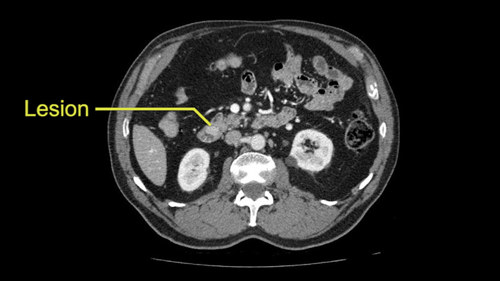
Ampullectomy [Case 4]
Imaging Analysis
Look through the patient's CT scan to identify any areas of concern for the necessary procedure.
Axial Venous

Ampullectomy [Case 4]
Surgeon's Impressions
Dr. Gallinger's critical imaging findings:
- Cutting through duodenal wall
- Locating pancreatic duct
- Avoid narrowing lumen of duodenum
Summary of surgeons' findings and slowing down moments:
Operating surgeon’s findings and slowing down moments:
Dr. Gallinger’s critical imaging findings:
1. Cutting through duodenal wall
2. Locating pancreatic duct
3. Avoid narrowing lumen of duodenum
Watch the following videos from the operation to see some of the key moments in the case.
Watch the following video for the operating surgeon's summary of the case.
Key points from this case
Opening the duodenum and finding that the lesion is not on the ampulla, you can do a lesser operation, but you need to be mindful of some new potential issues like the minor pancreatic duct.
The issues that the surgeon identified preoperatively:
- Cutting through duodenal wall
- Locating pancreatic duct
- Avoid narrowing lumen of duodenum
The issues were demonstrated in the intraoperative videos. The good news is that ampullectomy is technically more difficult, challenging and dangerous than a duodenal polyp excision, which is essentially what this turned into. In terms of decision making, whether we should continue or do something different, perhaps a whipple operation, we reflected on the fact that this is a carcinoid tumor, which is felt to have low malignant potential based on its size and location. We felt that a local excision would be adequate.
From a slowing down perspective, the first was appreciating that the tumor was not in the location as expected so that area of uncertainty or moment of concern where something is different than you expect so there is a mental slowing down but also a real physical slowing down because things were not what we thought. Then of course, the addition of a new slowing down issue or moment because of the potential for damage to the pancreatic duct that we couldn’t see. It was perhaps related to the location of the polyp and the minor duct even though we were pretty happy with the major duct and the bile duct, which were the initial concerns at the time of doing an ampullectomy.
So we didn’t do an ampullectomy, we just did a polyp excision and everything seemed to go okay.
We prepared for an ampullectomy because that would be the greater of potential procedures. Being prepared for the worst case scenario is a good idea in general. But then, opening the duodenum and finding that it is not on the ampulla, other than being happy that you can do a lesser operation, I think you need to be mindful of some new potential issues like the minor pancreatic duct as I mentioned. So that would be kind of the teaching point from my perspective is, when there’s a moment of uncertainty you have to really clear your head and make sure you’re thinking of all the issues, not just the fact of what you’re not doing now, but what you are about to do.