Puestow Procedure [Case 22]
Introduction
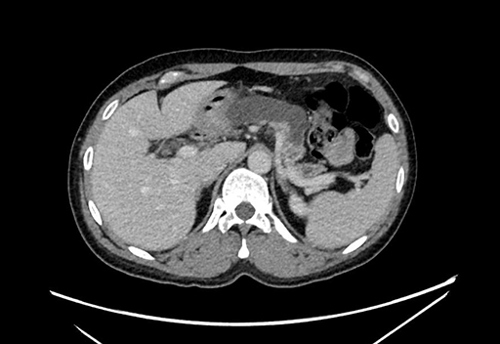
This is a case of a 44-year old woman who first presented 12 years ago with abdominal discomfort and pain. Imaging showed a dilated pancreatic duct that tapers to a stricture, but no specific etiology or evidence of malignancy was found. Her case was followed sporadically with imaging. Now, 10 years later, she returned with pain and an impressively large pancreatic duct measuring 2.7cm. Again, there is no evidence of a lesion and no stone disease. There is no dilatation in the biliary tree. Gallbladder is normal. She is not a diabetic and has no history of pancreatitis. A Puestow procedure with pancreaticojejunostomy reconstruction was recommended.
Puestow Procedure [Case 22]
Imaging Analysis
Look through the patient's CT scan to identify any areas of concern for the necessary procedure.
Surgeon's Impressions
Watch the following videos of the surgeons preoperative plans for the case. Compare their findings with your own analysis.
OR Footage
Summary of surgeons' findings and slowing down moments:
Dr. Gallinger’s procedure-specific moments:
- Finding pancreatic plane: avoid splenic vein, artery; duodenojejunal flexure
- Locate pancreatic duct, ductotomy
- Pancreaticojejunostomy, side-to-side anastomosis
Dr. Greig’s procedure-specific moments:
- Preserve gastroepiploic vessels
- Obtain adequate exposure of anterior pancreas surface
- Intraoperative ultrasound to confirm duct
- Longitudinal ductotomy
- Prepare adequate length of jejunum for Roux loop
- Careful anastomosis, especially at corners
- Close mesenteric defect
Watch the following videos from the operation to see some of the key moments in the case.
Watch the following video for the operating surgeon's summary of the case.
Key points from this case
When the pancreatic duct is very dilated, be sure you have correctly identified the correct structures. While 6-cm is the suggested length of longitudinal opening for the duct, always exercise judgment to determine what is appropriate for each situation.
The key moments that the surgeons collectively identified preoperatively:
- Preserve gastroepiploic vessels
- Finding pancreatic plane, avoid splenic vein, artery, duodenojejunal flexure
- Locating pancreatic duct
- Adequate longitudinal ductotomy
- Selecting length of jejunum for Roux loop
- Pancreaticojejunostomy side-to-side anastomosis
- Closing mesenteric defect
And that's what we performed. We did it through an open operation. Relatively small incision. I'm sure it could be tackled through a minimally invasive approach as well.
Her pancreatic duct was definitely very dilated. It can be a bit tricky but in this case it was very easy because it was really bulging through the pancreas and lesser sac. And in this case it was easy to open up the pancreas for about six or seven centimeters just with cautery. Out came a lot of pancreatic juice we looked inside the duct and saw nothing untoward or worrisome. Certainly there was nothing neoplastic looking. Most people suggest that the pancreaticojejunostomy should be large and or wide so that it doesn't recur, a stricture does not recur. And onto a Roux limb we created a side-to-side pancreaticojejunostomy in the lesser sac. We brought the Roux limb through a defect in the mesocolon and the operation went smoothly and this patient actually has done well. We'll have to see long term if it helps resolve her symptoms.