Distal Pancreatectomy [Case 2]
Introduction
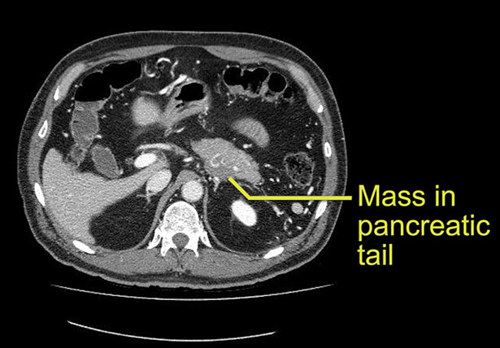
A 63-year old man presented with significant weight loss over several months. CT imaging showed an unusual abnormality in the tail of his pancreas. Work up included a percutaneous biopsy but results were inconclusive. A follow-up CT scan demonstrated interval growth of the lesion. A distal pancreatectomy was recommended.
Distal Pancreatectomy [Case 2]
Imaging Analysis
Look through the patient's CT scan to identify any areas of concern for the necessary procedure.
Axial Venous
Distal Pancreatectomy [Case 2]
Surgeon's Impressions
OR Footage
Summary of surgeons' findings and slowing down moments:
Operating surgeon
- Dr. Moulton's procedure-specific moments:
- Splenic artery
- Splenic vein
- Splenic mobilization
- Retroperitoneal dissection
- Critical imaging findings:
- Tortuous vessel in pancreas
- Tumor proximity to left adrenal gland
- Splenule
- Tumor proximity to duodenojejunal (D-J) flexure
Consulting surgeon
- Dr. Gallinger's critical imaging findings:
- Tumor proximity to blood vessels
- Tumor proximity to spleen
- Splenic vein
- Tumor proximity to left adrenal gland
Watch the following videos from the operation to see some of the key moments in the case.
Watch the following video for the operating surgeon's summary of the case.
Key points from this case
- Recognize adrenal gland involvement: anticipate difficulty in retroperitoneal dissection and potential need for adrenalectomy
- Dissecting celiac axis: determine the length of uninvolved splenic artery and its proximity to the celiac axis.
- Consider treating indeterminant lesions as cancer when diagnosis is uncertain.
The issues that the surgeons collectively identified preoperatively:
- Tumor proximity to blood vessels (splenic artery, splenic vein)
- Splenic mobilization
- Retroperitoneal dissection
- Tumor proximity to left adrenal gland
- Tortuous vessel in pancreas
- Splenule
- Tumor proximity to duodenojejunal flexure
Operating surgeon debrief: Dr. Moulton
The first 4 issues were demonstrated in the intraoperative videos. It was a distal pancreatectomy and a splenectomy. I’m still uncertain about what it is. It could certainly be an inflammatory lesion because there was certainly a sticky component around the tumor but it could certainly be something that’s more sinister. It didn’t exactly feel like a pancreatic cancer but it could be something else. Pathology is going to have to help us with the diagnosis. I certainly feel like we came around it and we treated it like it was a cancer and I think we got a good margin on everything.
The most difficult part was the retroperitoneal dissection, which we anticipated. The left adrenal was involved marginally so we actually came across the left adrenal and did not remove the whole thing but were obviously prepared to do that if there was bleeding. Fortunately we were able to just take off part of it to get a margin but leave some of it behind. So I think he’s got the majority of his left adrenal intact. But the retroperitoneal dissection was quite difficult. He was quite deep. We made a midline incision and perhaps we should have in retrospect made a left subcostal incision. Sometimes that actually gives us more access to the tail and the retroperitoneal dissection part.
The splenule I didn’t see. I think I felt it in the mesentery or in the fat between the colon and the spleen. I left it behind. The splenic artery was difficult to get at. Again, because the pancreas was quite high up and posterior, but we were able to get the splenic artery just at the origin and divide it. The splenic vein as well. We were able to get that separately and divide it. We didn’t see the duodenum, it wasn’t a problem.
Consulting surgeon: Dr. Coimbra [ENGLISH]
So after viewing some of the key points in the operation, I’d like to highlight one point which is the tumor in this location of the pancreas, very close to the neck or in the neck, we should be very careful with the gastric artery and veins because sometimes we may devascularize the stomach and you may have complications on the stomach due to ischemia and venous congestion sometimes so that’s one point to have attention.
After seeing all the details of the surgery, the plan I had was very similar to what was shown and I agree completely on the technical aspects of the surgery. The main points to have attention: the retroperitoneal margin, the splenic artery and vein, and of course the left adrenal gland. So I think these are the most important points to have an R0 resection and also be very careful with the manipulation of the tumor. So they did exactly. Very similar for what we would do in the same way and also taking out the spleen because there is a high suspicion of malignancy here. So I would make the same plan.
The only comment I would add is the oncological plan. If I had a positive biopsy before surgery, I would think about discussing about neoadjuvant treatment because the retroperitoneal margin was very close to the celiac axis in this situation but I would keep the same technical operation and procedure.
One important thing I think in all these cases is that besides knowing what we should be worried about (the margins, the retroperitoneum, the artery), to understand also what to avoid. We as surgeons should know what not to do in these situations. So we should be very careful when manipulating the tumor, be sure to cut the pancreas in the right localization, to also don’t have a positive margin in the pancreas. I would not try to do, even if technically it's feasible, I would not keep trying to do for example, in a minimally invasive way once we would probably have some hard time dissecting the retroperitoneum and the celiac axis, even though I see it’s very possible.
Also its very important in this situation, the preparation of the surgery. I think this patient should have a good evaluation of performance status and if we have any doubt, give the patient a good nutrition preparation for the surgery too.
Consulting surgeon: Dr. Coimbra [PORTUGUÊS]
Bem, depois de a gente ver o vídeo, a explicação da cirurgiã que fez o procedimento fica muito claro realmente, eu acho que as ideias foram muito parecidas e as preocupações em relação as margens do retroperitônio, ao coto da artéria esplênica e veia esplênica, a dissecção cuidadosa do tronco celíaco, realmente foram muito importantes.
Além é claro da ampliação de margem para a adrenal esquerda como tínhamos comentado através do exame de tomografia.
O plano que eu faria era o mesmo. Eu só discutiria se a biópsia fosse positiva no início, talvez fazer um tratamento neoadjuvante com quimio e radioterapia, considerando a margem muito próxima no tronco celíaco e no retroperitônio. Apesar de tecnicamente a margem ter sido adequada.
Um ponto que chamou a atenção, muito bem comentado, é que nos tumores de corpo pancreático, mais próximo do colo pancreático ou tumores do colo, muitas vezes há necessidade de ligadura da artéria gástrica esquerda e muitas vezes da drenagem venosa do estômago.
E que, portanto, muitas vezes esse estomago pode ficar congesto ou ate mesmo sofrer uma isquemia arterial ou por congestão no pós-operatório. Então, temos que ficar atentos a essa possibilidade.
Em algumas situação ate se no intra-operatório a gente perceber uma congestão importante, há necessidade de gastrectomia parcial por envolvimento dos vasos que irrigam e drenam o sangue venoso do estomago.
Outro ponto importante, que além dos pontos principais que a gente já comentou, é que o cirurgião tem que saber muito bem o que não fazer. Então é muito importante a gente ficar atendo na manipulação cuidadosa, ter muito cuidado na secção da margem do pâncreas, se possível ate confirmar com exame de congelação se houver duvida nas margens.
Preparar esse paciente, não levá-lo desnutrido para cirurgia. Esse paciente por exemplo tinha uma perda de peso importante, se houver qualquer sinal de desnutrição maior ou risco nutricional, nos faríamos um tratamento nutricional pré-operatório para esse paciente.
E também obviamente na suspeita de algum implante ou de uma doença metastática, não prosseguir com uma cirurgia paliativa de grande porte alto risco nessa situação.