Hepaticojejunostomy Revision [Case 18]
Introduction
This is a 68 year old man who underwent a Whipple (pancreaticoduodenectomy) operation 10 months ago for a T3 N1 bulky duodenal tumor. There was no biliary involvement at the time, with a common bile duct approximately 2.0mm in size. A routine hepaticojejunostomy reconstruction was performed in a running fashion using 6-0 absorbable suture, at the level of the common hepatic duct at the junction between the common hepatic duct and the cystic duct stump.
The patient then received 8 courses of chemotherapy. During this time, he experienced bouts of intermittent jaundice with fever, diagnosed as cholangitis that progressed to jaundice and biliary obstruction. A percutaneous transhepatic cholangiogram (PTC) was attempted several times but due to the biliary stricture, internalizing the PTC was unsuccessful. An external PTC was put in place. Multimodal imaging demonstrated a stricture at the location of the previous hepaticojejunostomy site with no evidence of metastasis or recurrent disease.
The plan is to perform a hepaticojejunostomy revision.
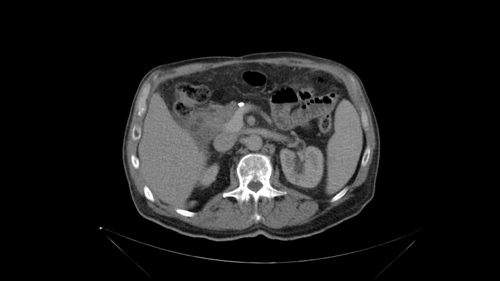
Hepaticojejunostomy Revision [Case 18]
Imaging Analysis
Look through the patient's CT scan to identify any areas of concern for the necessary procedure.
Surgeon's Impressions
Watch the following videos of the surgeons preoperative plans for the case. Compare their findings with your own analysis.
OR Footage
Summary of surgeons' findings and slowing down moments:
Operating surgeon
- Dr. Wei's Patient specific findings:
- Review prior report
- Identify site of obstruction
- Evaluate for soft tissue
- Evaluate prior duodenal limb
- Margin, oncologic status
- Porta hepatis anatomy
- Replaced hepatic artery
- Procedure-specific moments:
- Adhesiolysis, exposure
- Confirm anatomy of:
- biliary system, duodenal limb, anastomoses,
- portal vein, replaced hepatic artery
- Unexpected findings
- Confirm location of obstruction
- Posssible new roux-en-Y limb
Consulting surgeon
- Dr. Greig's Patient imaging findings:
- Identify site of obstruction
- Rule out mass
- Intraoperative decision:
- Revision of existing H-J
- New roux-en-Y reconstruction
- Leave transhepatic biliary tube
- Procedure-specific moments:
- Rule out carcinomatosis
- Preserve previous anastomoses
- Locate neo-duodenum, bile duct
- Decision on neo-duodenum
- Mobilize bile duct off portal vein
- Preserve RHA during hepatic duct dissection
- Duodenotomy, Reconstruction
Watch the following videos from the operation to see some of the key moments in the case.
Watch the following video for the operating surgeon's summary of the case.
Key points from this case
In redo- or revisional surgery: take time to carefully review prior procedural details. During surgery, ensure sufficient adhesiolysis, adequate exposure, and confirm all anatomy before proceeding.
When deciding between revisional approach or constructing a new roux limb for hepaticojejunostomy: locate the site of obstruction, evaluate the mobilization, length, and status of the hepatic duct and neo duodenal limb.
The issues were demonstrated in the intraoperative videos. So at the time of surgery, we initially started with a midline laparotomy which is what he had for his previous operation. We spent time with adhesiolysis and exposure and then we were able to evaluate the intraoperative findings for this gentleman.
What was interesting for him is that we were able to confirm that the site of stricture was at the level of the hepaticojejunostomy construction. He did have an anastomosis between his common bile duct at the level of the insertion between the common bile duct and the common hepatic duct. [and] He had a dilated cystic duct stump. The question that we had is whether or not the dilation of the cystic duct stump perhaps exacerbated his obstruction by adding a component of external compression to the patient’s biliary system that would make the jaundice worse.
In addition, the reconstruction of the hepaticojejunostomy was done at the level of the common bile duct rather than higher up in the liver at the level of the common hepatic duct, above the insertion of the cystic duct stump and this may have contributed somewhat to his stricture.
The last finding is that we did not find any evidence of recurrent tumor or soft tissue in the area. Though we did excise the stricture and send it to pathology for confirmation of the nature of the stricture on final pathology. In addition, the neo duodenal limb was easy to mobilize and certainly there was enough length to reconstruct a hepaticojejunostomy using the same neo duodenal limb that we had initially performed the Whipple procedure with. I think that we were quite well prepared for this case. I don’t think that there were any substantial unanticipated findings at the time of surgery. I must comment that the remnant cystic duct stump was quite interesting. It is something that we often teach each other may be a cause of post-op problems and I wonder in this patient if that could have contributed to his situation.