Laparoscopic (distal) pancreas resection [Case 11]
Introduction
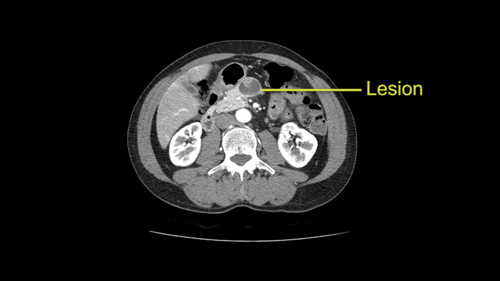
This is a 71-year old man with history of kidney stones who was referred with an incidental finding of a lesion in the neck of the pancreas. The complex lesion measures 3.1 x 2.8cm with solid and cystic features. It was biopsied to be a neuroendocrine tumor. There was no dilatation of the pancreatic or biliary ducts, and no evidence of local vascular invasion. The plan is to do a laparoscopic distal pancreatectomy with possible splenectomy and possible conversion to an open procedure.
Laparoscopic (distal) pancreas resection [Case 11]
Imaging Analysis
Look through the patient's CT scan to identify any areas of concern for the necessary procedure.
Laparoscopic (distal) pancreas resection [Case 11]
Surgeon's Impressions
OR Footage
Summary of surgeons' findings and slowing down moments:
- Tumor proximity to celiac axis, superior pancreatic border
- Cystic nature of lesion
- Tumor proximity to portal venous structures
- Proximity of pancreatic tail to spleen
- Decision for splenic preservation
- Possible conversion to open procedure
- Tumor location in head, neck of pancreas
- Retropancreatic tunnel dissection: SMV, splenic vein, IMV
- Alternative approach: central pancreatectomy
- Aberrant hepatic artery, celiac origin
- Tumor proximity to middle colic vessels
- Intraoperative ultrasound
Watch the following videos from the operation to see some of the key moments in the case.
Post-op Debrief
Watch the following videos for the surgeons summaries of the case.
Key points from this case
When deciding whether to preserve the splenic vessels in a spleen preserving distal pancreatectomy, evaluate the anatomical relationship of the vessels at both the transection margin and the tail of the pancreas, and take care in any dissection at the splenic hilum.
Dr. Sean Cleary (Operating surgeon)
The issues were demonstrated in the intraoperative videos. Having completed the case, we were reasonably pleased with how all of the aspects of the case went. Most importantly, we were able to obtain an adequate margin medially on the pancreas. We were able to transect the neck actually to the right of the superior mesenteric vein, and we were able to do that laparoscopically, which was quite favorable. We had no problems developing the neck behind the SMV. I think the patient’s anatomy helped us in that regard, also the fact that he was thin and the structures were easy to locate.
We did elect to perform a spleen preserving procedure and we also were able to preserve the splenic vessels. It’s nice because it has a potentially slightly lower rate of splenic thrombosis or ischemia and so it just happened that this gentleman’s anatomy was somewhat favorable from the fact that the vessels were proceeding along the superior border of the pancreas rather than the vein and artery being deeply embedded into the pancreatic tissue.
Final thing that we were able to do was take significant care in mobilizing the tail of the pancreas out of the hilum of the spleen. Again we were able to dissect it out carefully without compromising the splenic vasculature or getting into bleeding complications in that regard. So above all, I think we were able to progress through a lot of the challenging moments of the case that we had discussed, without significant difficulty or tribulations and that allowed us to sort of hopefully obtain the best operative results.
Dr. David Cavallucci (Consulting surgeon)
So having watched the video I guess the initial thing is obviously the operating surgeon has performed a different procedure to the one I’ve discussed and as I said, the decision making there is really dependent on your comfort levels and on some patient details which we don’t necessarily all have. And obviously it was a very nicely performed procedure and I think there’s not really any new information from the videos that would have necessarily changed my plan. I mean I think looking at the video and then of the tumor, its still certainly be amenable to do a central laparoscopic central pancreatectomy as the surgeon has said, the patient’s anatomy is quite favorable and I think it’s probably one of the nice learning points. When you look at the CT scan, you can see that the artery is really high on the superior border and similarly the vein is not too deeply embedded in the pancreas as sometimes it can be. That’s made vessel preservation in these circumstances easier and it would also make a central pancreatectomy easier as well. I would probably still, after seeing the video, still proceed with doing a central pancreatectomy. Again, I don’t think there’s anything on there that would say that it couldn’t be done in a similar fashion. Indeed, probably looking at it now, you can see how easily the tumor lifted off of the veins that it could be pretty straightforward.
Going into these procedures you often go in the fallback that okay a default operation would be a distal pancreatectomy and splenectomy with division of the vessels and you think if that’s your fallback then you know that that’s your back-up plan and then I think you can say well are we going to be able to do a vessel preservation and that’s what Sean’s done at every step is to look at the relationship of the vessels. Has it come off here in the tail? Sometimes that anatomy with the pancreatic tail with the hilum can be so challenging that it’s difficult to separate from the small branches and you know you’ve done that bit and its become clear and it’s fine and then he’s come more medially and again we quite easily get the vessels off and so his decision making has become more and more confident during the case and he’s been more and more confident he’s going to be able to do vessel preservation and splenic preservation. I think that’s a really good way of doing distal pancreatectomy like this is not being so set in your ways at the start but having that as a plan with a really good fallback plan.
Probably one of the, not a disagreement but a difference of opinion about the dissection ways and we argue, we argue about this a lot is how you approach the pancreas and the vessels. Do you do a lateral to medial dissection or an inferior superior dissection or medial to lateral. I think if you look at the way Sean’s approach is he’s largely done an inferior to superior dissection and a lateral to medial dissection and that’s a perfectly reasonable way of doing it. The only point I would make if you are doing a lateral to medial dissection is that you need to take a lot - and you’re not doing a lot of superior dissection which you know I was speaking about in the preoperative phase, for me, that’s one of the things I do quite early in the procedure is define that superior margin because then you have a lot more comfort as you get more medially. So if you look in the video in this area here, you can see that with the pancreas tented up, the splenic artery is coming down in the picture and Sean’s made a very clear mental note that you need to be careful of the common hepatic artery here and that’s because you’re sort of approaching or running into the side of it in a way and so generally what I would prefer to do is to define that margin on the superior part earlier in the case so that even if you do do a lateral to medial dissection when you get to that medial part, you’re comfortable the artery is in fact already detached and so you’re not worried that you’re going to suddenly run into the side of it. Now obviously that’s one way of doing it. The other way is to just do what Sean’s done, which is to be very careful during this part of the dissection to make sure he doesn’t run into the side of it and I think that’s sort of a very good learning point in that no matter which way you decide to do the dissection, it’s valid similarly to do the dissection as a medial to lateral way as well.
Dr. Nicolas Jarufe [Español] (Consulting surgeon)
Hemos visto, el video de la cirugía que se hizo en este caso que es decir un pancreatectomía corporocaudal, en este caso se preservo el bazo con preservación tanto de la arteria como de la vena esplénica, que probablemente, habíamos hecho algo similar.
Algunos puntos que tal vez habrían sido distintos en nuestro caso, y creo que es mejor ir lo antes posible al cuello del páncreas, buscar el puente preciso del cuello pancreático, es ahí donde se hace más fácil rodear el cuello sobre la vena mesentérica superior. En el caso que vimos recién, esto se hizo más bien al final de la cirugía, hacerlo antes ayuda porque una al traccionar el páncreas o el cuello, una vez que uno corta el páncreas, uno puede traccionar el cuerpo y cola y se muestra mucho mejor los vasos esplénicos y las ramas que uno debe ir ligando a ese cuerpo y cola del páncreas.
En respecto a lo que comentaba al comienzo para poder hacer esta sección del cuello del páncreas es muy importante tener disecado y libre la arteria hepática tal como se mostró acá, se puede liberar, y eso permite, transectar o cortar el cuello pancreático de forma más segura.
Respecto al corte, usamos una estapler tal y como se ve en el video de carga blanca, que es más hermético y más vascular, y nos parece que cortando al nivel del cuello que es más delgado con una sutura mecánica vascular, queda más cerrado el muñón pancreático y menos riesgo de fistula pancreática posoperatorio. Existe el riesgo igual, pero al menos se puede disminuir con el corte. A diferencia de lo que vimos ahí que uso dos disparos, lo ideal, desde mi punto de vista es que sea un solo disparo en el cuello del páncreas, y para eso lo tiene que tener muy bien disecado el cuello de manera que el stapler rodee completamente el cuello pancreático y se pueda usar una sola carga, para cortarlo, y no tener que cortar una vez y posteriormente una segunda vez y que eso puede también, producir mayor fractura del páncreas, y por lo tanto mayor riesgo de fistula. Eso respecto a diferencia o cosa que yo habría hecho distinto, el resto de la cirugía me parece que no hay mayores diferencias.
Dr. Nicolas Jarufe [English] (Consulting surgeon)
We have seen the video of the surgery that was performed in this case. The surgeon performed a distal pancreatectomy, in this case, the spleen was preserved with preservation of the artery and splenic vein as well. We would have probably done something similar.
We would have probably done some steps a little different. In this regard, I think that its better to go first to the neck of the pancreas, find the precisely the pancreatic neck because its there where its easier to encircle the neck above the superior mesenteric vein. In the procedure we just saw, this was done at the end of the surgery. Doing it earlier helps because when you grasp the pancreas or the neck, once you transect it, you can retract the body and tail and in this way, it will show much better the splenic vessels, and the branches that we need to preserve.
Regarding what I mentioned at the beginning, to be able to address the transection of the pancreatic neck, it is necessary to have dissected and freed completely the hepatic artery, just as it was shown here. This allows you to transect or cut the pancreatic neck in a safe manner.
Regarding the transection, we use a stapler, just like the one in the video, using a “white cartridge”, which is more airtight and more vascular, and we think that cutting the pancreas at the neck, which is thinner, using a mechanic vascular suture, the pancreatic stump will be closed better and therefore there will be less risk of post-op pancreatic fistula. There is always a risk, but at least it can be reduced with this type of stapler. Different from what we saw in the video, where he fired twice, ideally, from my point of view is to only use one stapler fire at the neck of the pancreas, and for that, you need to have the neck well dissected in a way so that the stapler can fully go around the neck, and in that manner you can fire only once to transect it, and avoid cutting in multiple attempts which could create a bigger fracture of the pancreas, thus higher risk of fistula. These are the major things that I would have done different. With respect to the rest of the surgery, I don’t have any major differences.